Bionic Vision: Optical Flow and Obstacle Avoidance Aesthetics Inspired by Insect Vision
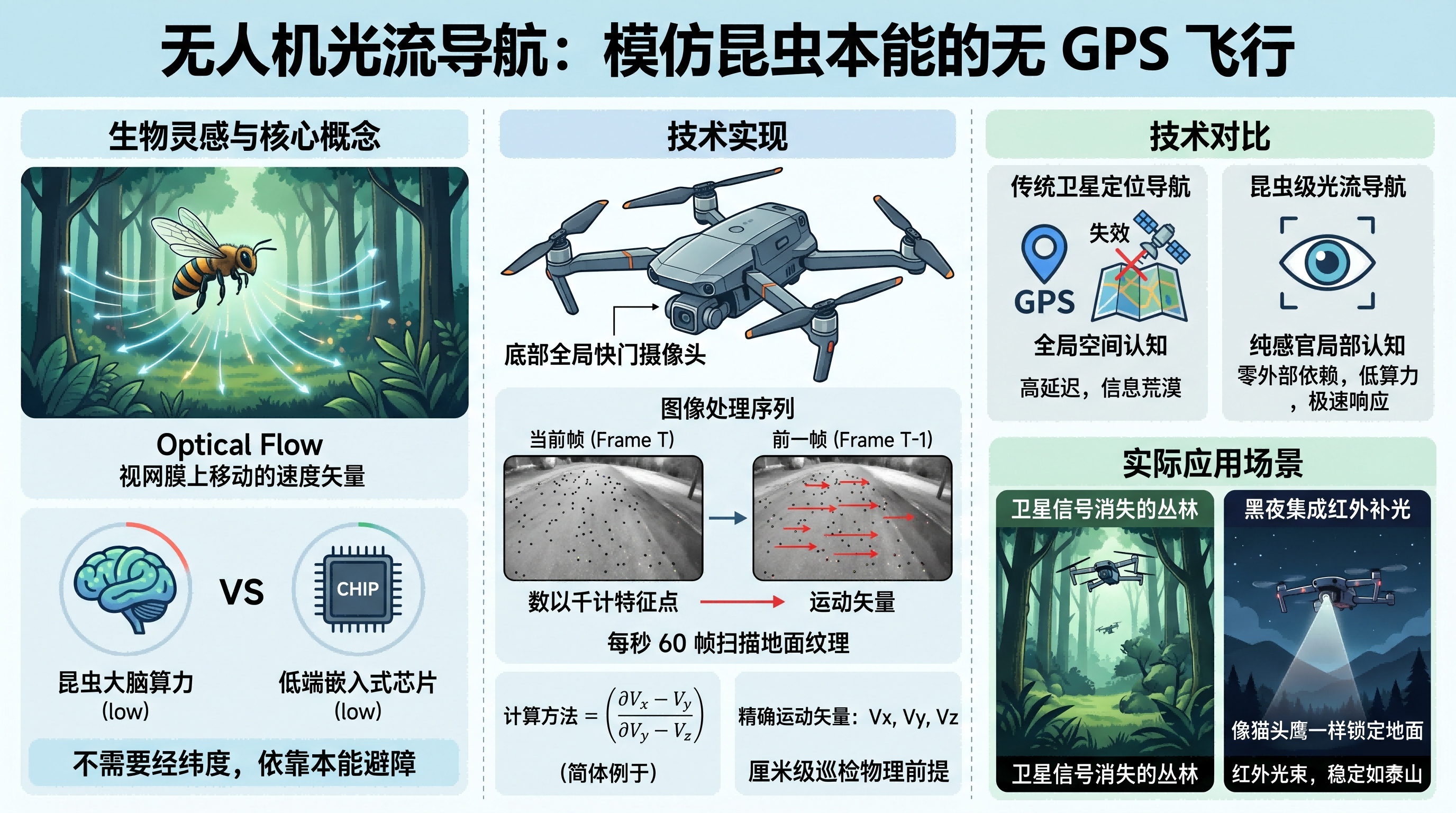
Human navigation logic relies heavily on global spatial cognition—we need to know longitude and latitude, and we need reference maps. However, nature's obstacle avoidance experts—such as flies and bees—possess brain power inferior even to the lowest-end embedded chips, yet they can weave through dense jungles at high speeds without colliding. This miraculous instinct stems from their keen perception of "Optical Flow." In essence, optical flow is the velocity vector of environmental objects moving across the retina (or image sensor). Modern autonomous drone navigation systems are deeply mimicking this insect-like obstacle avoidance aesthetics, aiming to construct an instinctive flight logic within the "information deserts" where satellite signals completely vanish.
In technical implementation, a global shutter camera at the bottom of the drone scans ground textures at 60 frames per second or higher. The optical flow algorithm calculates the precise motion vector of the airframe relative to the ground by comparing the displacement of thousands of feature points between two consecutive frames. This is fundamentally different from traditional satellite positioning: it doesn't care "where I am on Earth," but only "how far and how fast I am moving relative to the environment beneath me." This purely sensory logic is extremely efficient; it requires neither massive geographic databases nor expensive computing resources. This stability is the physical prerequisite for achieving centimeter-level inspections. Even in pitch-black nights, by integrating infrared illumination, the optical flow system can lock onto tiny ground ripples like an owl, ensuring the flight platform remains rock-steady.
A deeper breakthrough lies in the application of "Visual Divergence." When a drone rushes toward a wall at high speed, feature points in the image rapidly spread outward from the center. By calculating this rate of divergence, onboard AI can instantaneously estimate the "Time-to-Contact" without needing specific distance values. This obstacle avoidance logic based on time rather than distance is the secret to insect survival in complex dynamic environments. Modern industrial drones combine this bionic optical flow with deep learning models, granting them the ability to understand environmental semantics. It can distinguish whether the object ahead is a swaying willow branch (traversable) or a hard power line (must be bypassed). This evolution from "obstacle detection" to "environmental understanding" grants drones the survival wisdom to adapt to complex industrial ruins or forest disaster sites.
Furthermore, the performance of optical flow in low-power obstacle avoidance is exemplary. Compared to LiDAR, which can consume dozens of watts of power, optical flow systems require minimal energy to maintain all-weather perception. This ultimate deconstruction and reshaping of natural intelligence is eliminating the final operational blind spots for industrial drones. It grants cold silicon machines a kind of "spatial intuition" akin to biological instinct. This intuition allows drones to no longer stop rigidly when facing sudden obstacles but to slide past gracefully like an acrobat. This "agile" flight performance marks that drones are bidding farewell to the era of stiff mechanization and evolving towards a more harmonious and autonomous bionic era.