Edge Computing Redefining the Logical Depth of Low-Altitude Perception
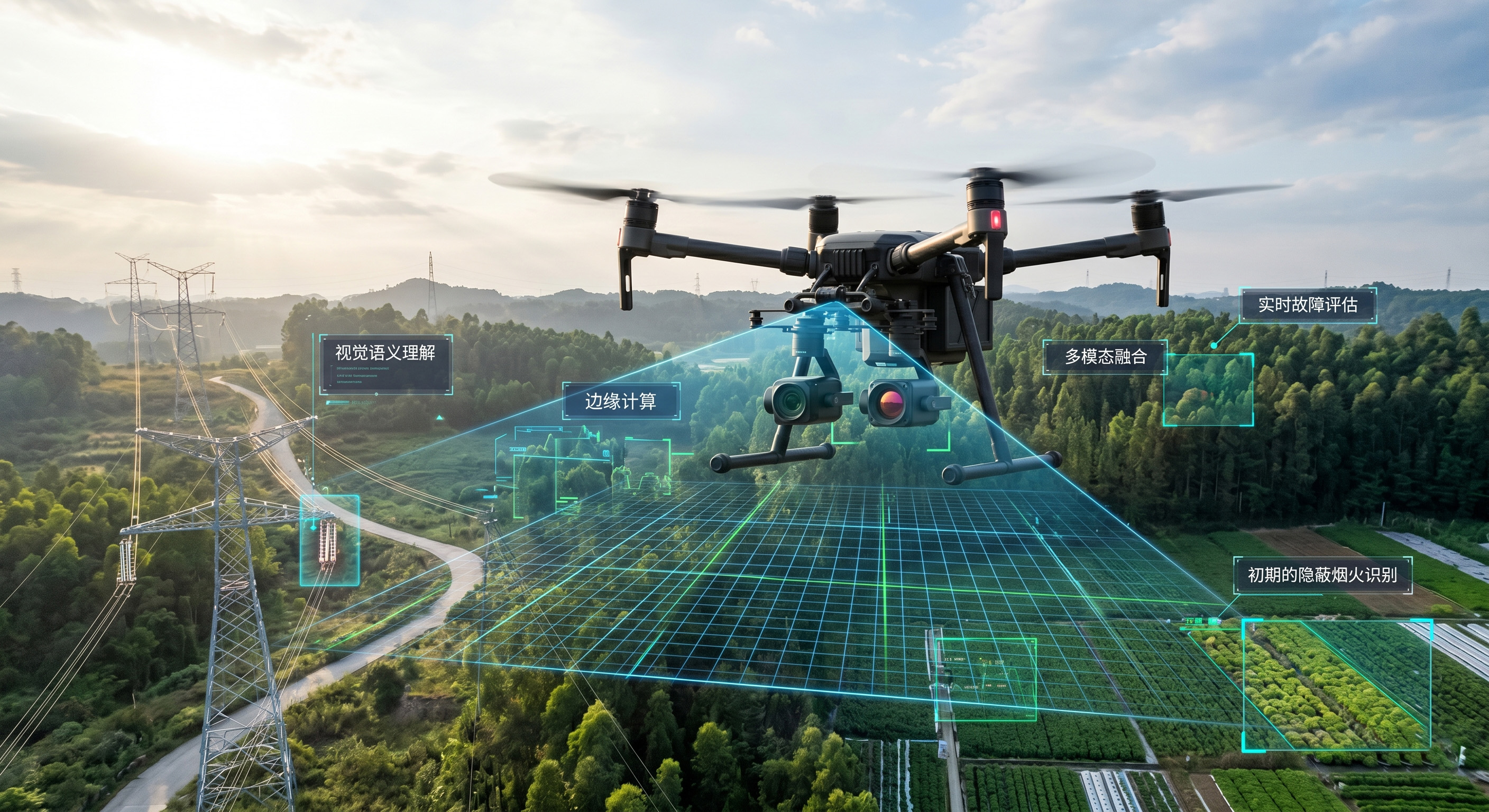
In the past decade, drones primarily played the role of "flying cameras" in the public eye. However, with the explosion of the low-altitude economy, we are witnessing a profound awakening in the dimension of perception. As drones evolve from simple remote pixel collectors into mobile computing terminals equipped with powerful edge computing capabilities, the way they interact with the physical world has undergone a fundamental change. The core of this transformation lies in the understanding of "visual semantics": drones no longer just record changes in light and shadow, but real-time comprehending the physical attributes, movement trends, and deep logical relationships of objects within the frame.
This leap from "seeing" to "understanding" is the logical starting point for reshaping industrial efficiency. In complex power inspection scenarios, traditional methods involved taking thousands of photos and uploading them to a backend for manual or cloud-based comparison. Now, edge computing modules integrated onboard can directly identify millimeter-sized cracks on insulators during flight. It doesn't just find faults; it evaluates the physical urgency of the fault by factoring in current gust speeds and environmental humidity. This real-time, logically deep perception transforms the drone from an "expensive sensor carrier" into an "aerial expert" with preliminary judgment.
The technological foundation supporting this awakening is the super-fusion of embedded Neural Processing Units (NPUs) and lightweight deep convolutional neural networks (CNNs). Since many industrial operations—such as cross-province transmission line inspections, forest fire prevention, and oil/gas pipeline patrols—occur in remote areas lacking 5G or high-bandwidth coverage, moving AI algorithms to the "edge" of the aircraft has become a technological necessity. To run complex vision algorithms within constrained power and heat dissipation environments, modern drones employ extreme algorithm compression techniques, including model quantization, pruning, and knowledge distillation.
Take forest fire patrols as an example: the value of edge AI is fully realized here. Traditional infrared payloads are often misled by sunlight refraction, heat-retaining rocks, or shimmering water surfaces, generating numerous false alarms. An edge terminal with semantic understanding can filter out these interferences within milliseconds through multi-frame correlation analysis, precisely capturing early hidden fires. This capability for "local perception and local decision-making" significantly reduces the pressure on expensive satellite or microwave backhaul bandwidth. More importantly, it shortens response times to within the limits of human reaction speed. When the information flow is purified at the edge, the drone gains a "digital intuition," capable of capturing fleeting risks within millisecond windows.
A deeper transformation lies in the omniscient perspective brought by "multi-modal semantic fusion." Next-generation professional flight platforms no longer rely solely on visible light but perform real-time registration of data from thermal imaging, multispectral sensors, and LiDAR at the edge. This fusion is not a simple layering of images; it constructs a 3D digital model with semantic tagging. In precision agricultural protection, drones can not only "see" crop height but also calculate the Normalized Difference Vegetation Index (NDVI) via multispectral data in real-time, dynamically adjusting spray pressure based on terrain slope. This ability to transform raw sensory data directly into production decisions marks the drone's evolution from a "remote control terminal" that passively executes orders into an "aerial collaborator" capable of understanding operational contexts and possessing logical closed-loops. When technology is endowed with the ability to understand the physical world, the operational boundaries of low-altitude airspace will extend infinitely. This evolution of perception will be the highest standard defining the competitiveness of future unmanned systems.