Open Skies, New Threats: How to Handle "Uninvited Guests" in the Era of Low-Altitude Airspace?
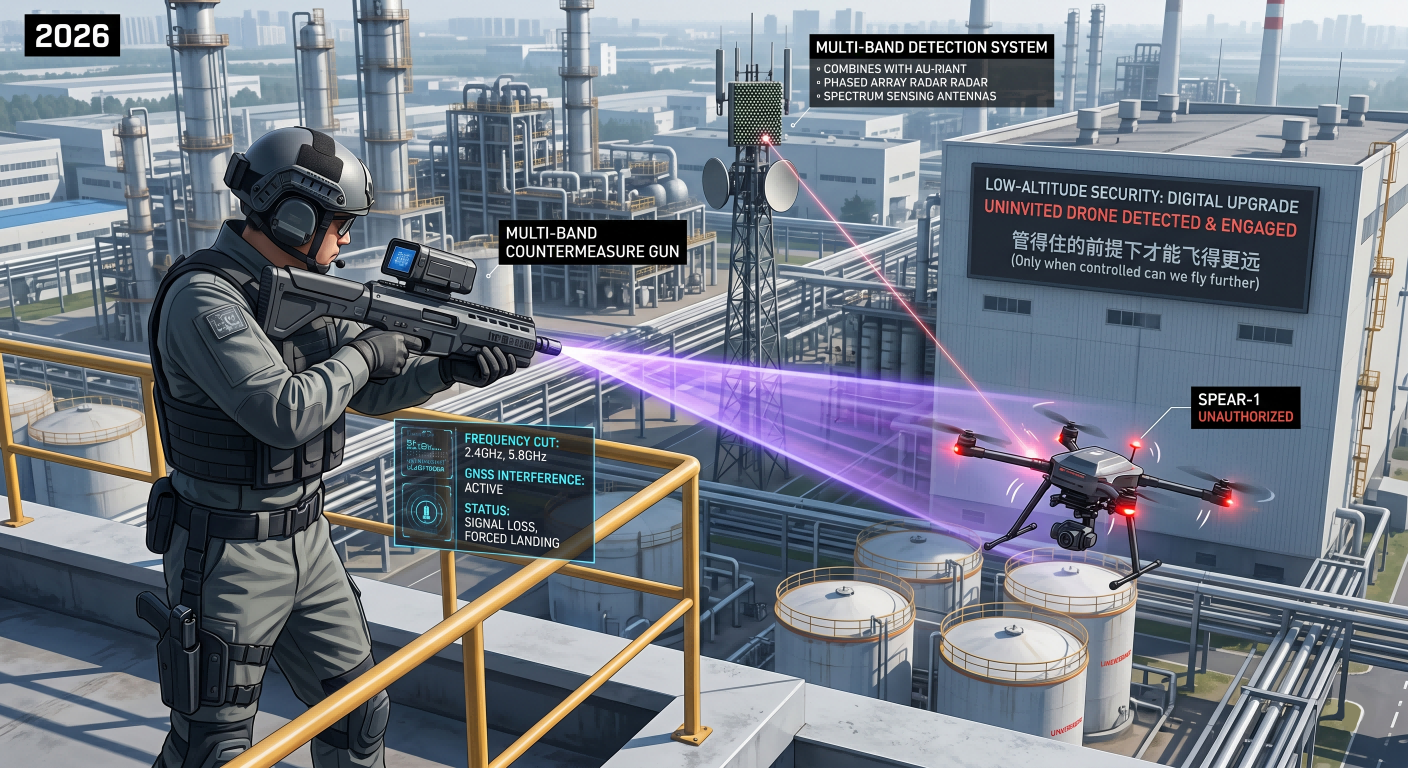
If 2026 is the "Year One" of the low-altitude economy, then safety and defense are the other side of that coin. With lower entry barriers for UAVs and the opening of airspace, the sky has become busier than ever. However, the resulting questions are increasingly sharp: what do we do when an unidentified drone appears over a chemical plant or hovers near an airport flight path?
I. The Pain of "Illegal Flights": Invisible Low-Altitude Threats
Traditional security thinking relies on "walls + surveillance," but in the 3D low-altitude domain, this logic fails. UAVs are small, fly at low altitudes, and have small Radar Cross Sections (RCS), making it extremely easy for them to bypass traditional defenses. Even more dangerous is that modern drones have evolved from simple analog signals to digital image transmission, even possessing autonomous obstacle avoidance and satellite navigation. This means traditional "jammers" may be inadequate. Simply emitting high-power noise might not only fail to drive them away but could also paralyze nearby legitimate communication networks.
II. From "Blind Jamming" to "Intelligent Countermeasure": The Art of Defense
In professional fields, we no longer speak of "Jamming" but of "Countermeasure." There is a qualitative difference between the two.
2.1 Multi-band Detection: The first step of defense is "seeing." In 2026, the mainstream solution is the combination of spectrum sensing and radar detection. By capturing the unique signatures of drone image transmission and remote control signals, the system can identify the brand, model, and even the serial number of a target from kilometers away.
2.2 Targeted Countermeasure: A true countermeasure system, such as the now-mainstream Multi-band Countermeasure Gun, acts like a scalpel. It can precisely sever the satellite positioning signals or remote control links of a specific target, forcing the drone to land on the spot or return home automatically, without affecting nearby aviation signals or civil Wi-Fi.
III. Offensive & Defensive Dialectics: Why Drone Makers Understand Countermeasures Better
There is an interesting phenomenon in the industry: the most advanced countermeasure equipment is often produced by companies that develop industrial-grade UAVs. The logic is simple: only those who know how the "Spear" is made know how the "Shield" should defend. Take industrial drones like the Spear Series; they possess strong anti-interference capabilities and frequency-hopping technology. Companies developing such machines naturally master the core codes of countermeasures while repeatedly testing how to break through interference. This "integrated offensive and defensive" perspective has facilitated the formation of a low-altitude security closed loop.
IV. Scenario Implementation: Digital Security Upgrades for Industrial Parks
Security is not a hindrance to development but its cornerstone. When we discuss the low-altitude economy, we should not only see the magnificence of the takeoff but also the rigor of the defense. Only when things are under control can we fly further.