Supporting the Weight of the Low-Altitude Economy
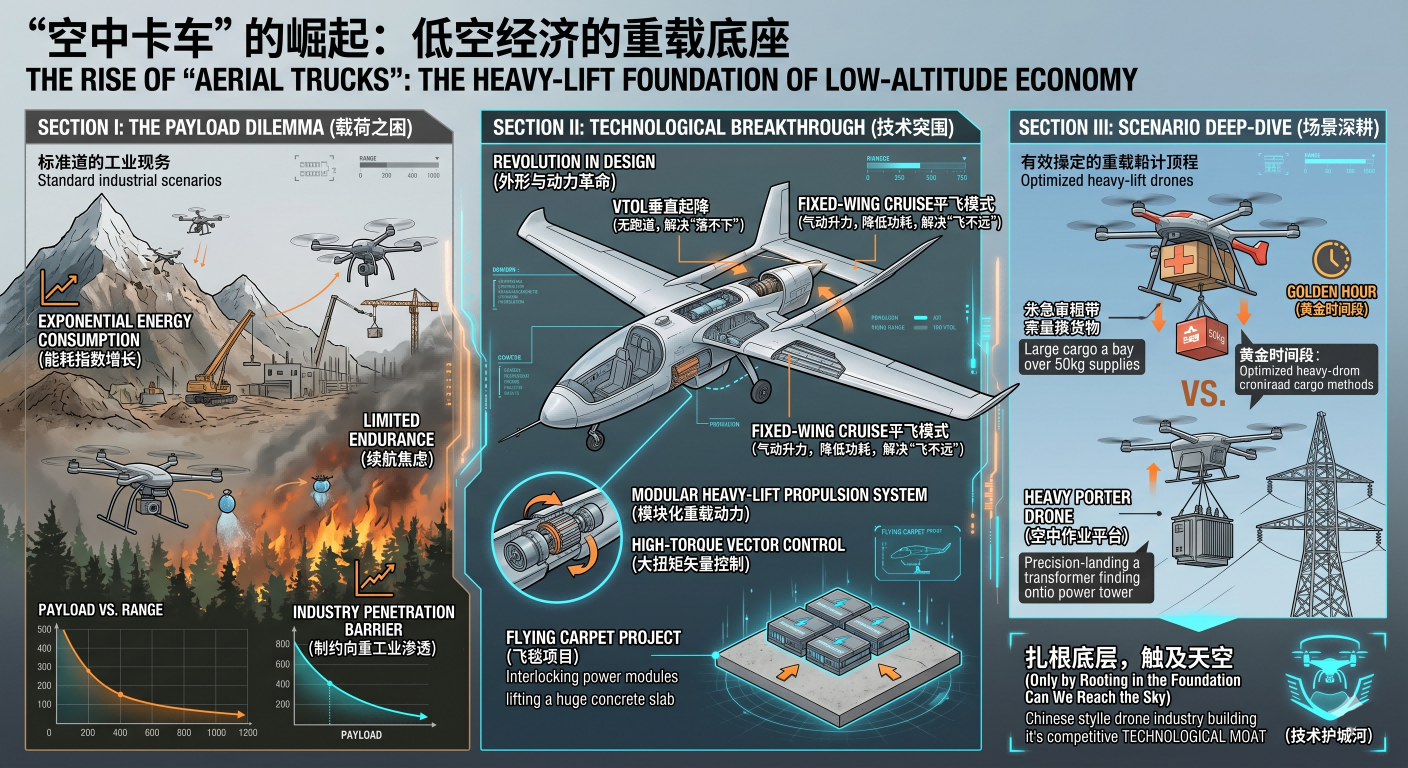
In 2026, the term "Low-Altitude Economy" has moved from government policy papers into everyday conversation. Yet, behind the hype of drone deliveries and air taxis, a fundamental and "hardcore" question remains overlooked: if UAVs are to truly replace human labor in heavy physical tasks on a large scale, how will they carry loads of dozens or even hundreds of kilograms?
I. The Payload Dilemma: The "Ceiling" of the UAV Industry
Over the past decade, the UAV industry has transitioned from simply "being able to fly" to "flying stably." However, to this day, most consumer and standard industrial drones remain trapped in a "lightweighting" cycle. In practical industrial scenarios—such as pulling heavy ropes for power line stringing, carrying fire extinguishing shells for forest fires, or transporting tower materials for mountain construction—traditional multi-rotor UAVs often fall short. As payload increases, energy consumption grows exponentially, and flight endurance is squeezed to just a dozen minutes. This "payload anxiety" has become the primary bottleneck restricting the penetration of the low-altitude economy into heavy industries.
II. Technological Breakthrough: Synergy between VTOL and Heavy-Lift Propulsion
To solve the payload issue, the industry is undergoing a comprehensive revolution from "airframe structure" to "propulsion systems." In 2026, Heavy-Lift Vertical Take-Off and Landing (VTOL) technology has become the key to breaking the deadlock. VTOL capability eliminates the need for expensive runways, solving the "landing" problem; while the fixed-wing mode in cruise flight significantly reduces power consumption through aerodynamic lift, solving the "range" problem.
However, the most difficult part is the heavy-lift propulsion unit. The current industry trend is a deep focus on high-torque motors and vector control systems. Take the "Flying Carpet" Project, which has garnered significant attention in the industry; its core logic is to use modular propulsion combinations to lift heavy loads steadily, much like the legendary carpet. This system requires not only massive thrust from the motors during takeoff but also precise energy management during high-speed flight.
III. Scenario Deep-Dive: From "Porters" to "Aerial Work Platforms"
With heavy-lift capabilities, the application logic of UAVs undergoes a fundamental shift.
The "Golden Hour" Rescuer in Emergencies: In the immediate aftermath of landslides or earthquakes, heavy-lift UAVs can deliver over 50kg of emergency supplies, communication base stations, or even small water purification devices in a single trip. This provides a level of rescue capability unattainable by traditional small drones.
The "Aerial Porter" for Power and Chemical Industries: Equipment that previously required a dozen people to carry can now be precisely landed on top of transmission towers or beside chemical reactors using VTOL-capable heavy-lift platforms.
This transition marks the formal evolution of UAVs from "flying cameras" into "flying cranes."
Only by Rooting in the Foundation Can We Reach the Sky
The prosperity of the low-altitude economy should not be limited to milk tea deliveries in urban areas. The "aerial trucks" silently performing heavy-lift tasks in deep forests and chemical parks are the true backbone of this industry. It is because projects like "Flying Carpet," which focus on the propulsion foundation, continue to push boundaries that China's UAV industry can build a truly competitive technological moat in an era of "spec wars."