The Stability Evolution of Heavy-Lift Platforms in Gusty Environments
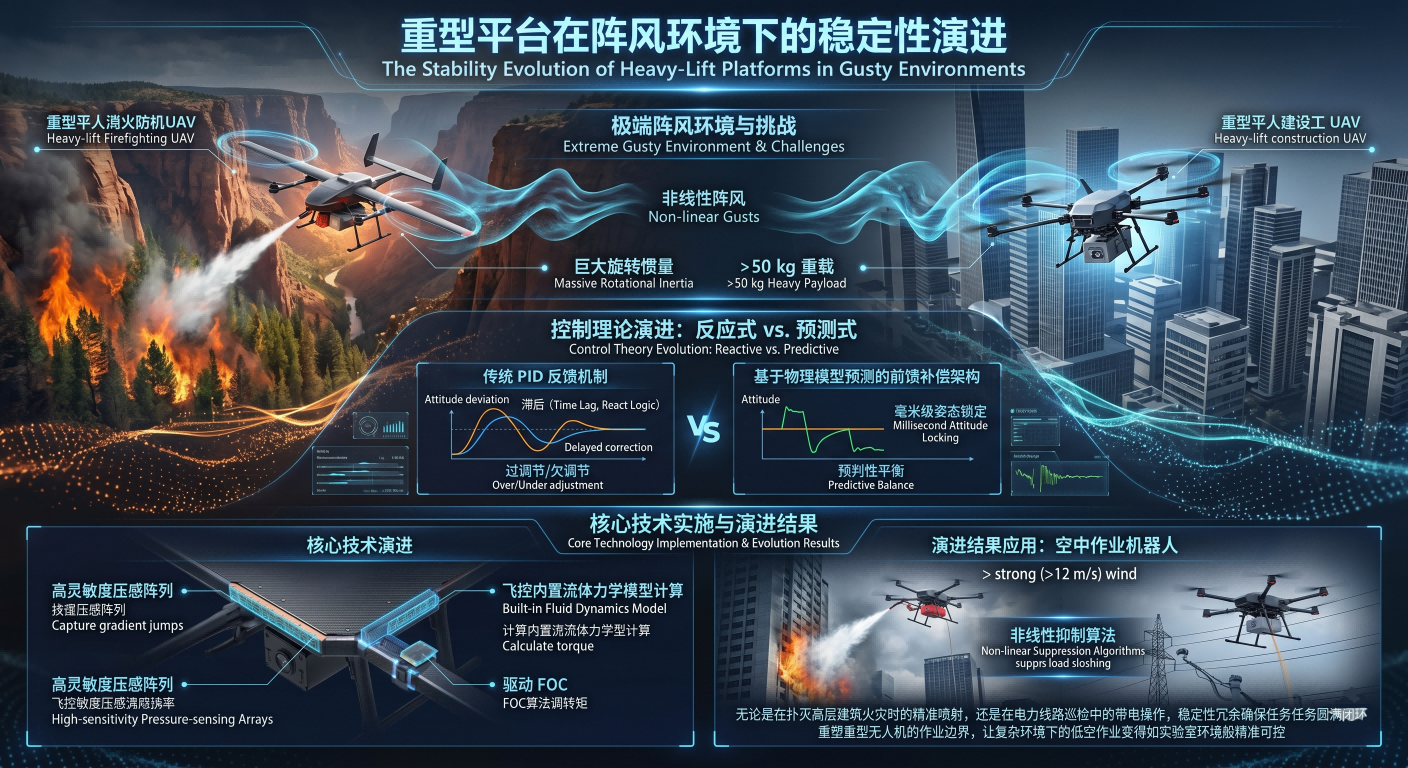
As heavy-lift UAVs become increasingly prevalent in emergency rescue, forest firefighting, and precision lifting, the aerodynamic challenges faced by developers have escalated. Especially in extreme environments such as deep canyons, high-rise building clusters, or offshore oil and gas platforms, unpredictable non-linear gusts pose a significant threat to flight safety. For heavy-lift platforms possessing massive rotational inertia, traditional control theories often prove inadequate when responding to sudden perturbations. The instantaneous pressure differential generated by gusts on the fuselage and rotors is intensely asymmetrical; should the system response lag even slightly, the aircraft may not only deviate from its intended course but could even suffer irreversible structural oscillations.
Traditional PID (Proportional-Integral-Derivative) feedback mechanisms possess an inherent "time lag" when addressing such issues. Because they must detect an attitude deviation before issuing a compensation command, this "reactive" logic often leads to over-adjustment or under-adjustment when dealing with heavy equipment carrying loads over 50 kg with extremely high centers of gravity. To fundamentally alter this status quo, modern top-tier heavy-lift flight platforms have begun introducing a feed-forward compensation architecture based on "physical model prediction." The core of this architecture lies in transforming the UAV from a passive recipient of forces into an active sensory entity, utilizing algorithms to preemptively predict environmental forces on the airframe, thereby achieving true millisecond-level attitude locking.
The realization of this technical path relies on high-sensitivity pressure-sensing arrays distributed along the edges of the frame. When lateral gusts touch the leading edge of the fuselage, sensors capture minute jumps in the pressure gradient during the early stages of airflow instability. The flight control system's built-in fluid dynamics model instantaneously calculates the impact of this airflow on each axial torque and directly drives the motor's FOC (Field-Oriented Control) algorithm to adjust vector output. This means that before the airframe produces any visible tilt, the power system has already completed the redistribution of force internally by adjusting torque. This "predictive" balancing mechanism allows the heavy-lift platform to maintain centimeter-level hovering precision even in harsh environments with wind speeds exceeding 12 m/s.
Furthermore, to address the sloshing effect generated by heavy payloads during flight, the system incorporates non-linear suppression algorithms. By modeling the motion modes of the payload in real-time, the flight control system treats payload oscillation as a type of interference torque and automatically injects cancellation components into the power output. This profound understanding of complex physical interactions elevates heavy-lift UAVs from simple "transporters" to precision "aerial task robots." Whether it is precision spraying during high-rise building firefighting or live-line operations in power line inspections, this extreme stability redundancy is the core trump card ensuring a successful mission loop. Through algorithmic refinement, we are reshaping the operational boundaries of heavy-lift UAVs, making low-altitude tasks in complex environments as precise and controllable as a laboratory setting.