Fusion of Perception and Intelligence: Onboard Edge Computing and Autonomous Obstacle Avoidance Systems
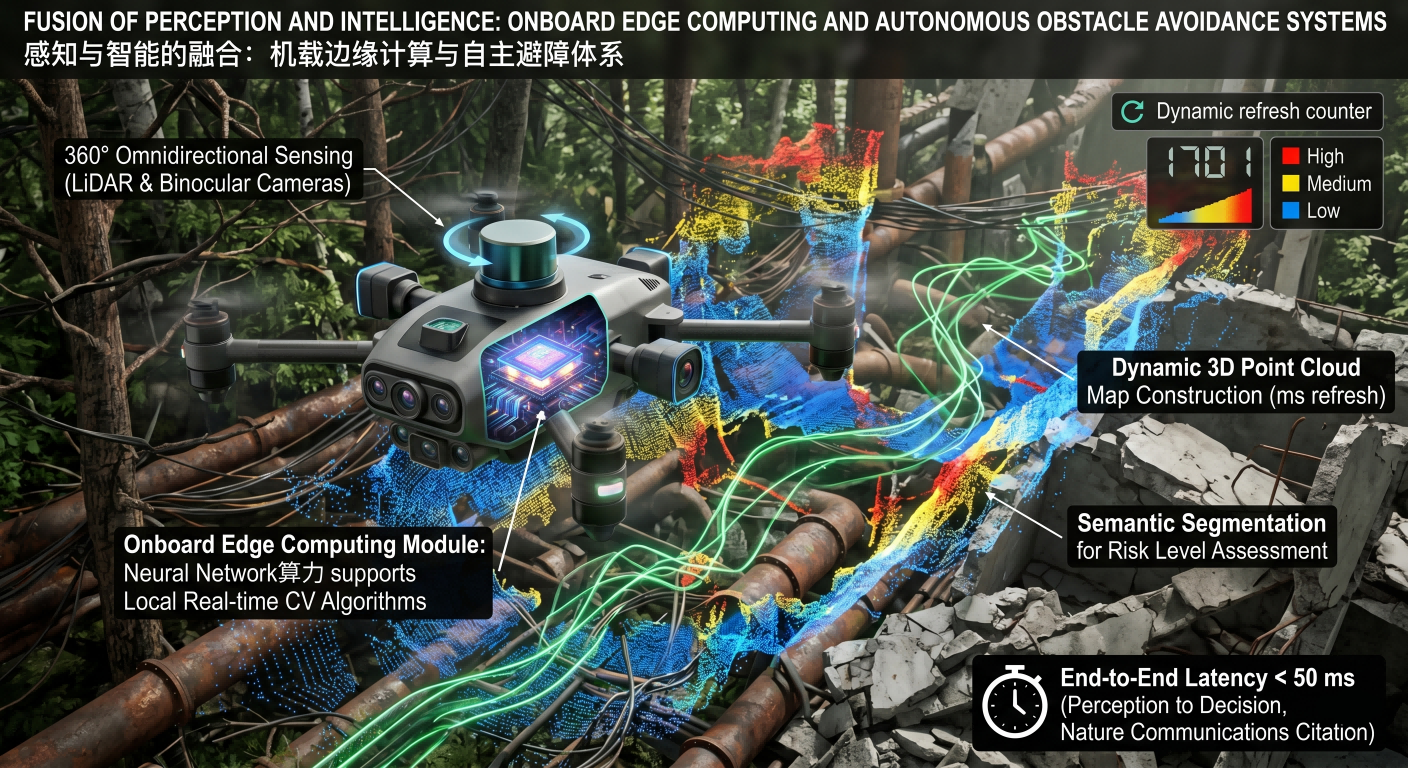
When UAVs enter complex forests or narrow pipeline corridors, relying solely on a pilot's experience becomes insufficient. True intelligence should grant the UAV the ability to "think autonomously," completing the "perception, inference, and obstacle avoidance" loop within milliseconds. The core bottleneck is the limitation of onboard computing power. Traditional cloud computing cannot meet real-time demands due to latency. As noted in Nature Communications regarding autonomous navigation, real-time avoidance requires end-to-end latency below 50ms. Therefore, UAV integrates high-performance embedded edge computing modules with neural network power sufficient to run computer vision algorithms locally. By fusing 360-degree binocular vision and LiDAR, the UAV constructs a dynamically refreshing "point cloud map" within its 3D space. It can identify small obstacles like wires and autonomously judge risk levels using semantic segmentation. Following perception is the higher-order "global path optimization." Traditional algorithms often simply "stop" or "reroute" rigidly, which is inefficient. Some UAVs introduced a path planning model based on RRT and Deep Reinforcement Learning (DRL), referencing optimal path algorithms in Robotics and Autonomous Systems. Upon detecting an obstacle, the system calculates hundreds of alternative paths in a fraction of a second, evaluating them for energy efficiency and smoothness. This "smooth bypassing" capability allows the UAV to make predictive maneuvers against dynamic obstacles like moving personnel. Furthermore, the system features "environmental adaptive learning"; after repeatedly flying through the same area, it optimizes cruise routes via a local database, achieving an intelligent leap from "passive avoidance" to "active optimization."
In the rapidly developing low-altitude economy, individual intelligence is evolving into swarm collaboration. According to Science Robotics, the core of swarm intelligence lies in distributed data processing and low-latency sharing. Likiu developed multi-machine collaboration protocols, allowing UAVs in the same airspace to share perception point clouds in real-time. When one UAV detects an obstacle in a blind spot, that information is instantly synced to the entire swarm, building a broader cognitive network. This deep fusion of perception and intelligence marks the evolution of UAVs from "flying tools" into "smart production systems." While significantly enhancing safety, it opens a new low-altitude track for industrial automation. Likiu remains dedicated to transforming cutting-edge academic results into reliable industrial products, defining the intelligent standards for future low-altitude operations.