Extreme Power Response: FOC Sine-Wave Drive and Closed-Loop Control of Heavy-Load Motors
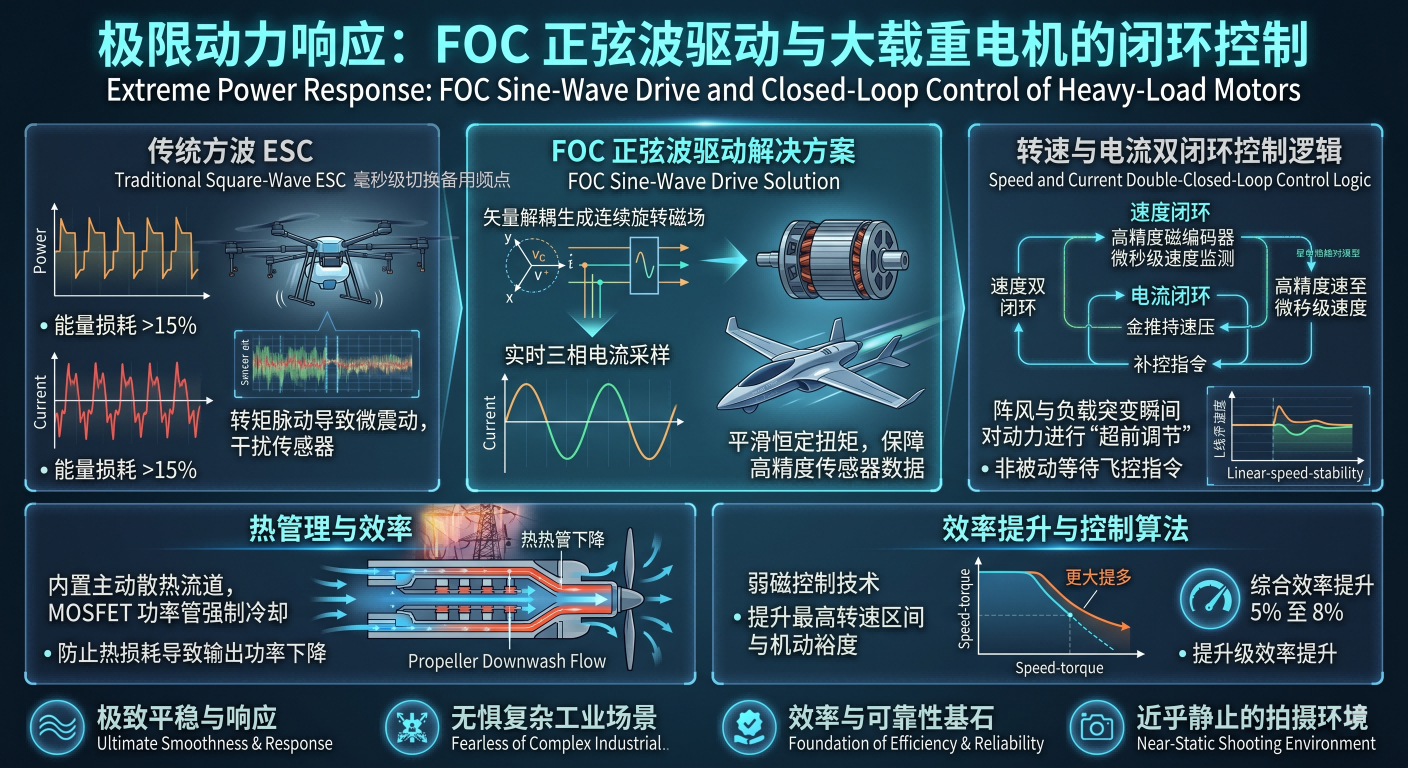
When heavy-load UAVs perform industrial missions, the stability of their power system dictates overall operational safety. Traditional square-wave drives (ESCs) generate significant torque ripple and high-frequency noise due to abrupt current switching. According to research in IEEE Transactions on Industrial Electronics, this torque ripple not only wastes over 15% of energy but also induces micro-vibrations in the airframe, interfering with the imaging quality of high-precision cameras. To achieve ultimate smoothness and response speed, Likiu has adopted a sine-wave drive solution based on FOC (Field-Oriented Control). By performing real-time sampling and vector decoupling of the motor's three-phase current, the FOC driver generates a smooth, continuous rotating magnetic field, allowing the motor rotor to obtain constant torque at any speed. This smoothness is critical when the UAV adjusts its posture while carrying heavy payloads (such as Spear pods), as it significantly reduces jitter caused by power fluctuations, ensuring the raw clarity of captured sensor data.
Another tough battle lies in the millisecond-level game of dynamic response. In strong gusts, heavy-load UAVs are prone to losing attitude control due to high inertia if power adjustments are delayed. UAV's motor control system introduces advanced speed and current double-closed-loop control logic, a design referencing high-performance servo control theories in Control Engineering Practice. Instead of passively waiting for flight control commands, the system uses high-precision magnetic encoders to monitor minute speed changes and compensates the drive current on a microsecond scale. This "advance regulation" allows the motor to maintain linear speed stability during abrupt load changes (such as sudden crosswinds or material dropping). Furthermore, addressing the temperature rise under high-current operation, we designed internal active cooling channels that utilize the propeller's downwash to force-cool MOSFET power tubes. Even under continuous high-intensity operation, working temperatures are suppressed within the ideal window, preventing output power drops caused by thermal loss (thermal throttling).
In the evolution of heavy lift UAVs, efficiency and reliability are eternal themes. Likiu's power architecture pursues not only burst power but also long-term operational life. Through self-developed algorithms, Likiu implemented "field weakening control," effectively increasing the motor's maximum speed range without increasing voltage, thereby enhancing maneuverability. As stated in IEEE Transactions on Power Electronics, optimized drive algorithms can improve overall motor system efficiency by 5% to 8%, which is vital for industrial UAVs seeking maximum endurance. This all-round optimization, from bottom-level current algorithms to thermal engineering, constitutes the power backbone of Likiu UAVs in extreme industrial scenarios. It ensures flight safety and provides a near-static shooting environment for industrial sensors through precise torque control. This respect for and refinement of power is the technological confidence behind our benchmarking against top international products.