Structural Mechanics and "Lightweight Violence" of Carbon Fiber Composites
In the aerospace sector, "weight" is an engineer's eternal nemesis. For drones, reducing a single gram of airframe weight often translates into an extra gram of payload capacity or several additional seconds of flight endurance. This relentless pursuit of mass reduction has led to the absolute dominance of Carbon Fiber Reinforced Polymers (CFRP). It is crucial to understand that carbon fiber is not merely "plastic reinforced with fibers"; it is a turbostratic graphite structure composed of graphite crystallites stacked along the fiber axis at a microscopic level. The tensile strength of this material is typically 7 to 9 times that of steel, while its density is only a quarter. In the design of drone arms and center frames, this "high specific strength" allows the structure to withstand high-frequency motor vibrations and violent maneuvering overloads while maintaining zero physical deformation.
This "zero-deformation" physical property is critical for high-performance drones. When motors rotate at thousands of revolutions per minute, they generate complex simple harmonic vibrations. If the airframe material lacks sufficient rigidity, these vibrations can trigger structural resonance in the arms, introducing noise into sensor data or even causing the flight control system's PID logic to fail. The high elastic modulus of carbon fiber effectively filters out these high-frequency interferences, making the drone as rigid as a solid piece of steel in the air. Furthermore, carbon fiber has an extremely low coefficient of thermal expansion, meaning the airframe structure will not suffer from internal stress caused by thermal expansion or contraction even when traversing extreme temperature gradients—from the freezing upper atmosphere to the scorching ground surface. This physical stability is the prerequisite for drones to serve as "high-precision measurement platforms" capable of centimeter-level mapping.
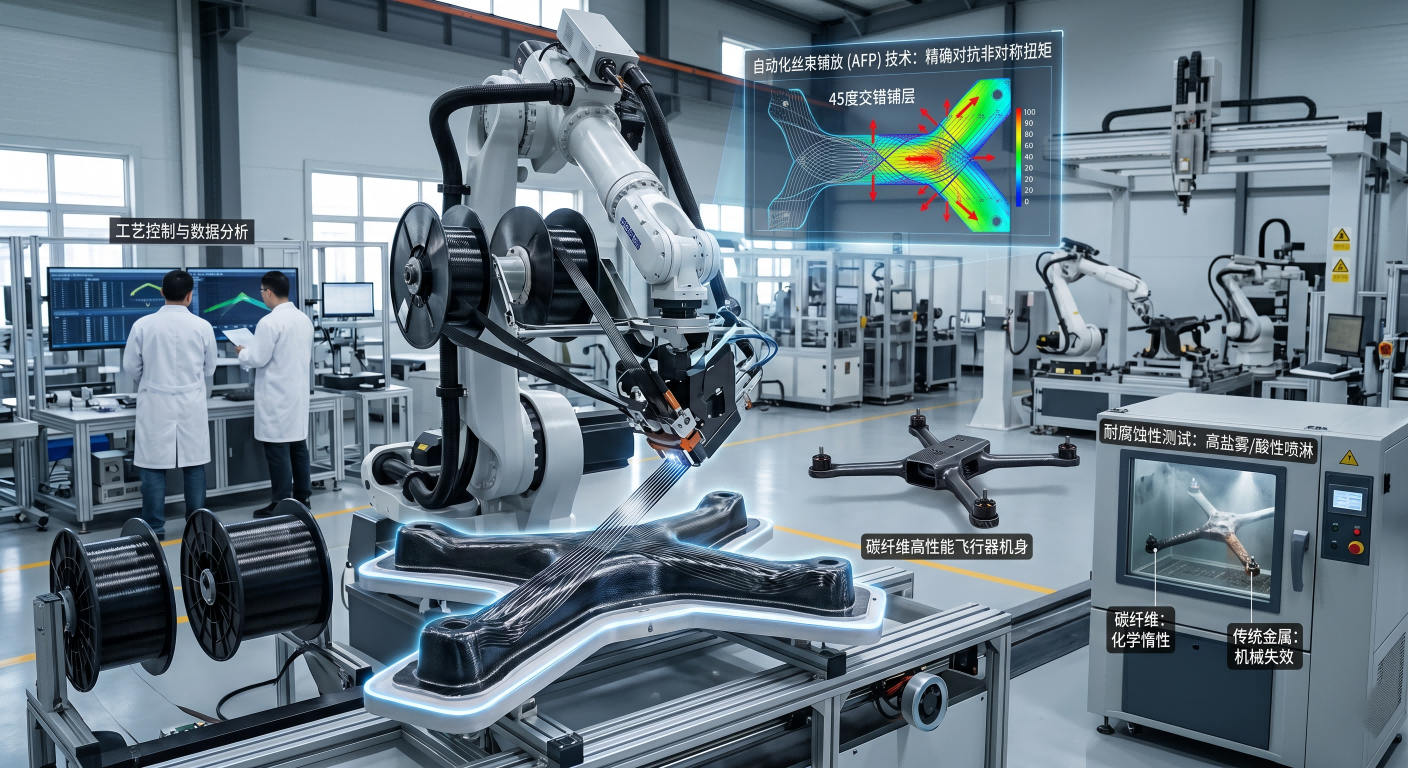
However, the true core competitiveness lies in the precision "anisotropic" layup process. Unlike the isotropic physical properties of metallic materials, the strength of carbon fiber is directional, granting designers a god-like "authority over stress distribution." The manufacturing of modern industrial drones is more akin to a "spatial weaving art." Engineers increase fiber density along the axes of maximum stress based on stress distribution maps derived from Finite Element Analysis (FEA), while reducing thickness in non-load-bearing areas. Through the overlapping of different weaving specifications such as 3K/12K and high-temperature curing of epoxy resin in vacuum autoclaves, the airframe achieves not only immense torsional stiffness but also natural damping characteristics. This "dimensional strike" in materials science allows the drone to absorb energy through interlaminar slippage of microscopic fibers during mountain gusts or sudden impacts, thereby shielding core electronic components from damage.
To achieve this goal, modern drone factories have introduced automated "tow placement" technology. The orientation of every carbon fiber strand is precisely calculated to counter asymmetric torques generated during flight. For instance, at the moment of takeoff for a quadcopter, the arms endure upward bending moments and rotational torque; by using a 45-degree staggered layup, these composite stresses can be perfectly offset. Additionally, the corrosion resistance of carbon fiber is far superior to that of metals. In coastal high-salt-mist environments or acidic gas spraying conditions in chemical plants, carbon fiber airframes exhibit near-eternal chemical inertness, preventing mechanical failure caused by structural fatigue. The popularization of this "black gold" material marks the transition of drones from the "hobbyist model stage" to the threshold of "high-performance aircraft." It is not just synonymous with lightness but is the perfect crystallization of "violent aesthetics" and precision engineering.