When Hundreds of Drones Begin to "Think Like a Flock"
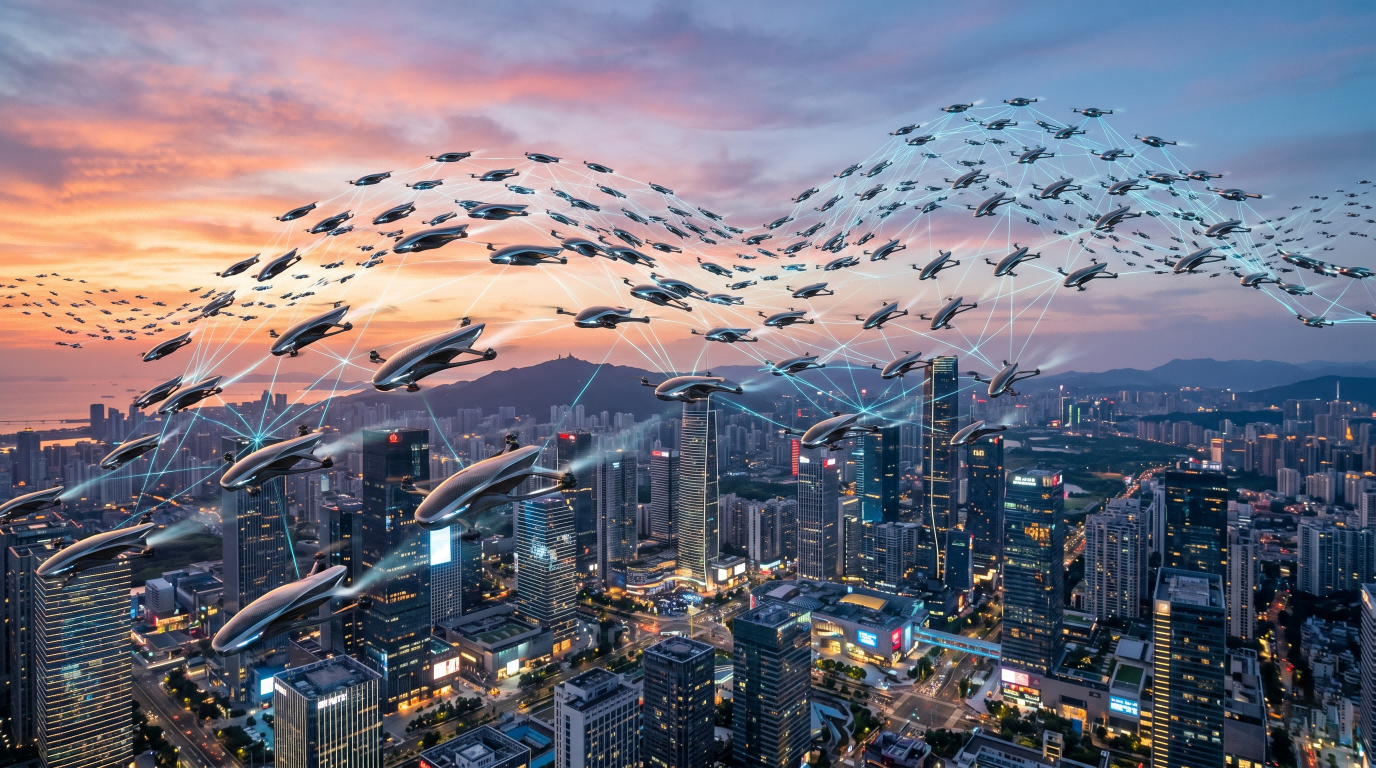
The intelligence of a single drone is merely an extension of human limbs and senses; but when hundreds of drones begin to collaborate as an organic whole, we truly touch the frontiers of "digital life." This is the "Swarm Intelligence" that has long fascinated the tech world. If you have ever observed thousands of starlings streaking across the sky at dusk, you would be amazed by that grand, almost supernatural sense of coordination: how do they never collide while moving at speeds of tens of meters per second? How can they instantaneously morph into complex geometric formations? There is no "central commander" with absolute authority behind this; each bird only needs to follow extremely simple local rules. The cluster coordination algorithms of modern drones are precisely the magnificent translation of this primitive natural wisdom onto silicon chips. Under a decentralized architecture, each drone only needs to focus on three dimensions: maintain a safe distance from neighbors, align velocity vectors with neighbors, and move toward a common goal.
This extremely concise set of local rules can burst forth with staggering computational power in an instant, supporting ultra-large-scale cluster operations. The essence of this algorithmic logic is breaking down complex "global planning problems" into countless "local interaction problems." For industrial applications, this is not just a visual spectacle but a revolutionary breakthrough in efficiency. Under traditional inspection models, one pilot controls one drone, and inspecting a 100-megawatt solar farm can take days; however, under the logic of "swarm coordination," an automated docking station can release dozens of drones simultaneously. They spread out like scattered water to evenly cover the entire airspace, with each aircraft sharing its location and scanned areas through a low-bandwidth neighbor interaction network (MESH). This coordination no longer relies on real-time ground remote control but instead fills gaps spontaneously via algorithms, achieving "carpet-style" saturated scanning of the target area.
The true charm and core hardcore metric of this coordination lie in its "dynamic self-healing capability" and "topological resilience." In traditional centralized control systems, the base station's signal tower is the "single point of failure" for the entire system: if the base station is damaged or the lead aircraft fails, the entire fleet falls like puppets with cut strings. But in a decentralized swarm algorithm, every drone is both an executor and a temporary "navigator." If 30% of the aircraft drop out due to heavy interference, physical damage, or battery depletion, the remaining group will not fall into chaos. They will instantaneously redistribute positions through real-time topological reconstruction—like flowing liquid or a healing wound—automatically filling gaps in motion to continue the preset mission. This logic, where "the whole is greater than the sum of its parts," is the technological foundation for achieving ultra-large-scale urban smart logistics, wide-area forest fire monitoring, and extreme disaster search and rescue.
Looking forward, this "swarm intelligence emergence" will not be limited to aircraft; it will evolve into a programmable, evolvable 3D physical neural network. When thousands of drones traverse the city skies in an orderly fashion, non-interfering, transporting goods and information required for city operations as efficiently and safely as flowing blood, we are effectively reconstructing a foundational logistical boundary for human society. This is no longer a plot from science fiction but a mathematical certainty based on Artificial Potential Field methods and non-cooperative game logic. By endowing machines with a "collaborative" soul, we have opened the doors to the era of "advanced low-altitude order." Every drone pulsing in the clouds is an active node within this massive neuronal network. They are no longer isolated individuals but the most vital and agile physical execution tentacles building the future digital twin world. This technological leap from individual intelligence to collective civilization is redefining human control over space.