The Challenge of Rarefied Atmosphere: High-Altitude Power Compensation and Flight Engineering in Extreme Environments
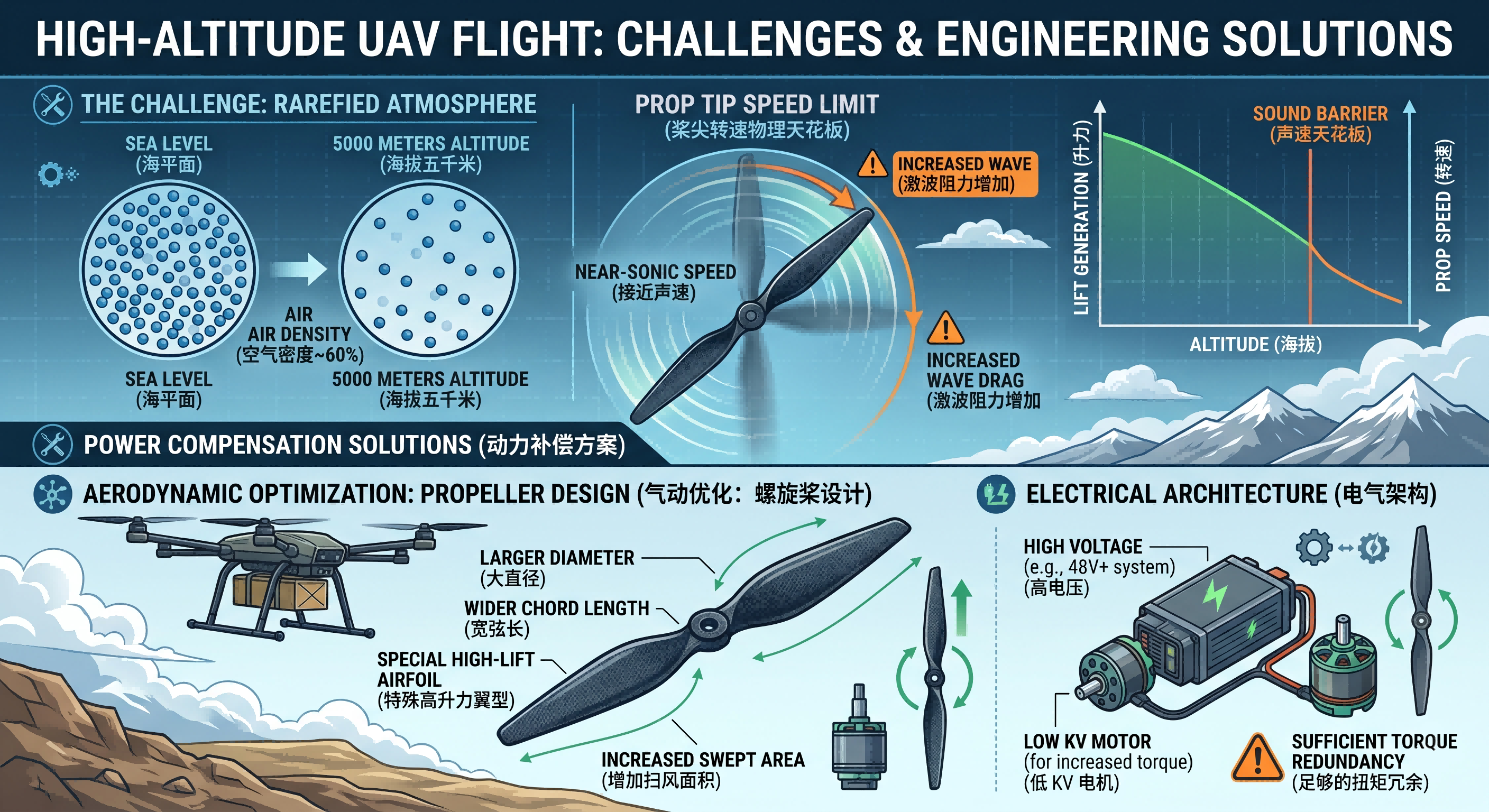
Pushing UAV applications from the plains to plateaus above 4,000 meters is by no means a simple translation of aircraft; it is a rigorous challenge to physical limits. As altitude increases, atmospheric pressure and air density drop sharply. At 5,000 meters, the air density is only about 60% of that at sea level. Because the
To offset the loss of lift, high-altitude UAVs must innovate their power architecture. Plateau models typically use propellers with larger diameters, wider chord lengths, and special airfoils to increase the swept area. However, increasing rotational speed is limited by a physical ceiling: as the propeller tip speed approaches the speed of sound, intense wave drag occurs. Consequently, power systems often adopt a "low KV, high voltage" configuration to ensure sufficient torque redundancy even under extreme loads.
Beyond aerodynamic performance, thermodynamic balance on plateaus is a major hurdle. Despite the low ambient temperatures, the efficiency of convective cooling via air drops significantly due to the thin air. When motors operate at high currents to maintain lift, electronic speed controllers (ESCs) generate immense heat. To prevent thermal breakdown, high-performance UAVs must employ customized active cooling systems, such as internal airflow ducts or high-thermal-conductivity alloy fuselages, ensuring core components stay within safe temperatures.
The electrochemical characteristics of batteries are particularly fragile at extreme low temperatures. When ambient temperatures drop below zero, the viscosity of the electrolyte increases, and the resistance to lithium-ion migration rises, causing a surge in internal resistance. During flight, this manifests as a "cliff-like" drop in voltage. Therefore, plateau UAVs are usually equipped with intelligent self-heating battery packs that use thermal elements to raise internal temperatures to an optimal range before takeoff and utilize discharge waste heat for insulation during flight, ensuring mission endurance in frigid, oxygen-deprived environments.